Introduction
When running Istio on Kubernetes (especially on AWS EKS), a common question is:
Should I put an Application Load Balancer (ALB) or a Network Load Balancer (NLB) in front of Istio?
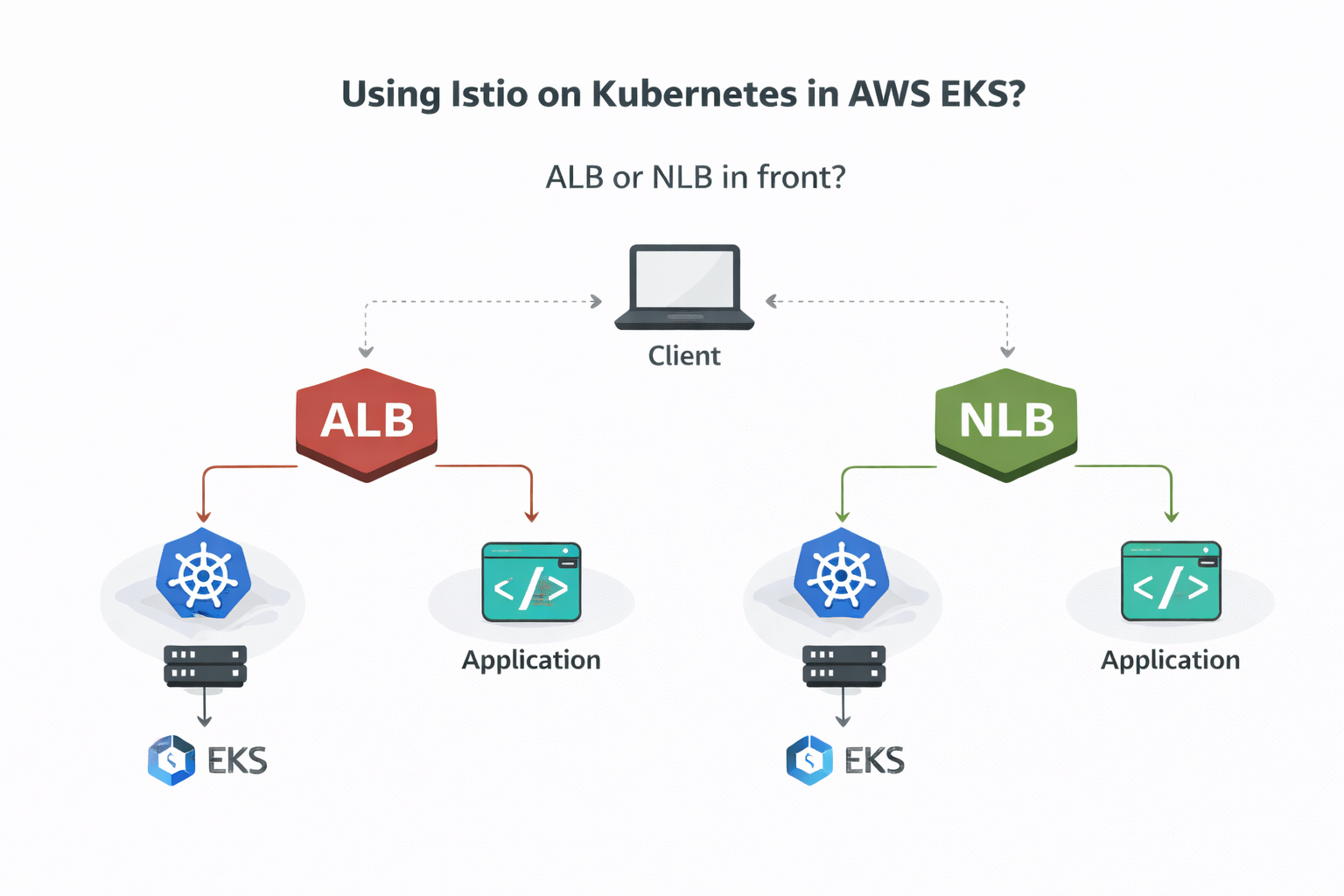
At first glance, both seem to work. Traffic reaches the cluster and the application responds.
But once you understand Layer 4 vs Layer 7 and how a service mesh is designed, the right choice becomes clear.
This post explains why NLB fits Istio better than ALB and how using ALB can lead to a double L7 anti-pattern.
L4 vs L7 (Only What Matters)
Layer 4 (Transport Layer)
Layer 4 is about connections, not requests.
It understands:
- TCP / UDP
- IP addresses and ports
It does not understand:
- HTTP paths
- Headers
- Hostnames
Example:
Connect to 10.0.1.5:443
➡️ AWS NLB works at Layer 4
Layer 7 (Application Layer)
Layer 7 understands what the request means.
It understands:
- HTTP / HTTPS / gRPC
- Paths like
/api/orders - Hosts like
app.example.com - Headers, retries, timeouts
Example:
GET /api/orders
➡️ Istio (Envoy) works at Layer 7
➡️ AWS ALB also works at Layer 7
What Istio Expects
Istio is a service mesh, not just a proxy.
It controls:
- Routing
- Traffic splitting
- Retries and timeouts
- mTLS and security policies
- Observability
All of this requires Layer 7 context.
So the key idea is:
Istio expects to be the single Layer 7 decision-maker.
ALB + Istio: The Double L7 Trap
Client
   ↓
ALB (L7)
   ↓
Istio Envoy (L7)
   ↓
Application
Here’s the problem:
- ALB inspects and routes HTTP
- Istio inspects and routes HTTP again
- Routing logic is split across two systems
- Health checks often conflict
- TLS is usually terminated before Istio
This creates unnecessary complexity and confusion.
NLB + Istio: Clean Separation
Client
   ↓
NLB (L4)
   ↓
Istio Envoy (L7)
   ↓
Application
With this setup:
- NLB only forwards TCP traffic
- Istio handles all HTTP logic
- No overlapping responsibilities
- Cleaner security and observability
- Fewer edge-case failures
This is the service-mesh-native design.
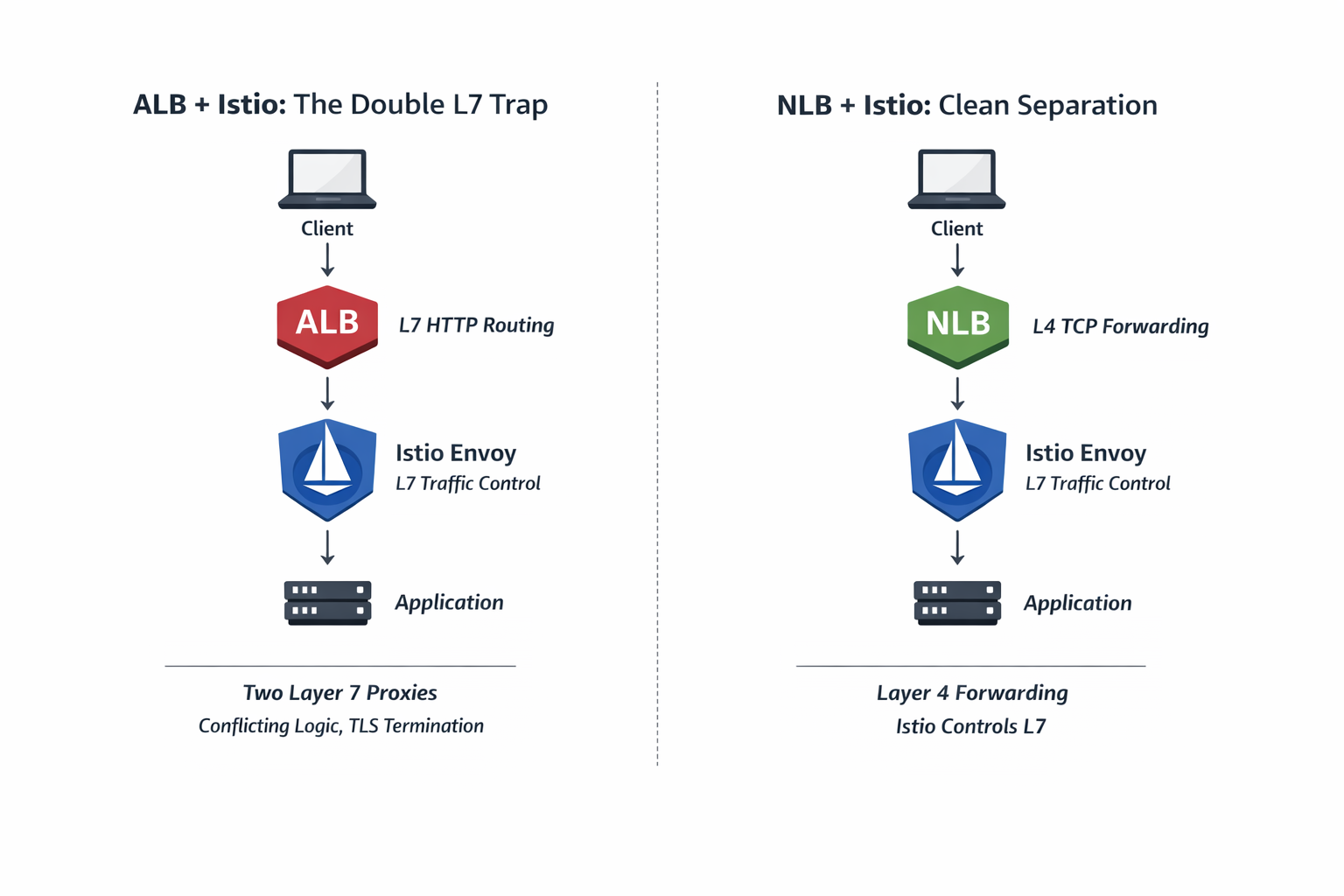
Left: ALB + Istio introduces two Layer-7 decision points (the Double L7 Trap).
Right: NLB forwards at Layer-4 while Istio remains the single Layer-7 authority.
Simple Analogy
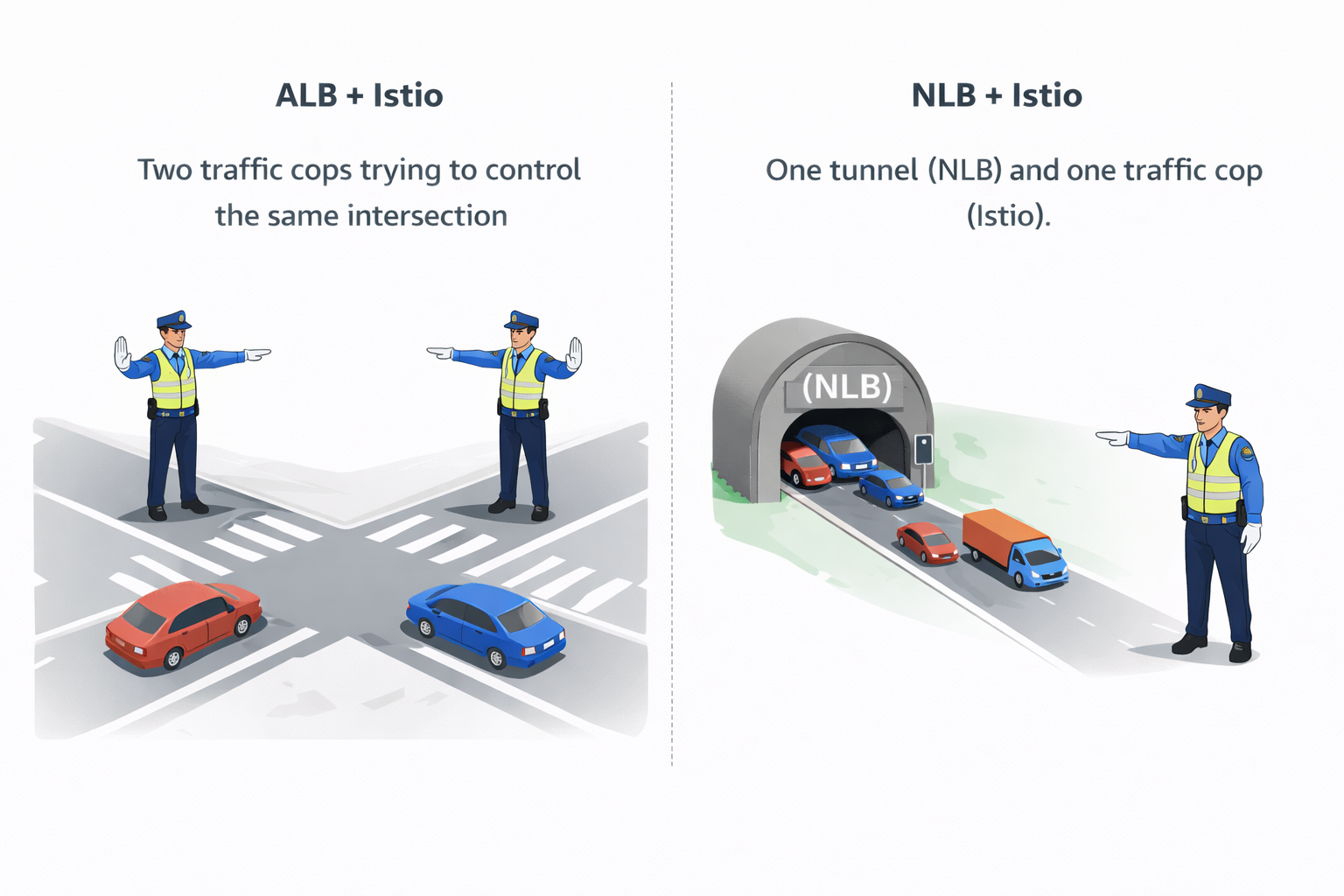
ALB + Istio
Two traffic cops trying to control the same intersection.
NLB + Istio
One tunnel (NLB) and one traffic cop (Istio).
When ALB Can Still Make Sense
ALB is fine if:
- You are not using Istio for ingress routing
- You want AWS-managed L7 routing at the edge
- Istio is used only for internal service-to-service traffic
But if Istio manages ingress traffic, ALB becomes redundant.
Final Recommendation

For Istio on EKS:
- ✅ Use NLB (Layer 4)
- ✅ Let Istio control Layer 7
- ❌ Avoid ALB + Istio ingress
Key Takeaway
A service mesh needs one Layer 7 brain.
Everything before it should stay simple and dumb.
That’s why NLB works best with Istio.